Thursday, June 3, 2010

Louise Bourgeois: Farewell to the Spiderwoman


The world said goodbye to one of the most acclaimed “artist’s artists” on May 31, 2010. Louise Bourgeois was not a household name, but she did influence several generations of artists with her provocative and seemingly contradictory images. Since she lived to the ripe age of 98—working well into her 90s—it is no surprise that multiple generations have looked to her for inspiration. It is hard to imagine artists like Kiki Smith creating such mythical and symbolic works without Bourgeois as a forerunner.

Bourgeois was born in France to parents who worked as tapestry restorers. The mosaic of that household, with all its traumas and dysfunctionalities, was the endless well for her creativity. Her father was a charismatic philanderer who openly carried on an affair with the live-in governess. Though her mother tried to shield the children from the situation, she also acted as if the affair did not exist. The artist, therefore, somewhat loved and distained both parents.
 
By 1938 Louise had met and fallen in love with an American art historian. They married and she moved with him to the United States. During the next decade she became ensconced in the old boys club of the mid-century artworld. She studied with Stanley Hayter and several of the leading Surrealists at Hayter’s relocated Atelier 17 in New York City. Though Bourgeois denied any attachment to Surrealism, she was part of the influx of European Modernists who had converged on New York, transforming it to the art capital of the world. She had a rather successful career during this time—a period when many outstanding female artists, such as Lee Krasner, were still relegated to the backseat of the artworld bus.
 

During the next two decades Bourgeois seemed to disappear into obscurity. She continued working steadily as her art, quietly, changed the way women were perceived within art society. The questions she was asking and the ideas she explored were especially influential on the new generation of feminist artists.

It wasn’t until 1982 that Bourgeois was suddenly omnipresent within the artworld. The Museum of Modern Art held a retrospective of her work—the first for a woman at that institution. At the age when most Americans would have been approaching retirement, Bourgeois was just about to begin the most important decades of her career. This is where the contradictions began to be evident. This tiny senior citizen was creating chiseled marble sculptures. This grandmotherly figure often produced overtly sexualized images—like the infamous sculpture tucked under her arm in her portrait photograph by Robert Mapplethorpe. But she also produced sensitive watercolors and doll-like figures sewn from her old clothing. The variety of materials appropriated always made her difficult to pinpoint.

 In recent years Bourgeois has most often been associated with her spider sculptures. These tend to be gigantic spiders that hover over the viewer, transforming him or her into prey. Typically exhibited in public settings, these spiders are made on a human scale. The spider image is derived from the artist’s mother and the family tapestry business. Bourgeois saw her mother as a protector and a weaver. Still, the ominous quality of the spiders cannot be fully explained through analogies to the artist’s mother alone.
The marble sculptures of Bourgeois exist singly, but also as elements within larger works. Often, they are in the form of disembodied appendages. The body is always the central image of Bourgeois’s work, even when it is absent. Hands, feet, and headless and armless bodies remind the viewer of the traumas of life and the severings that populate our relationships. Figures exhibit amputations that recall the effects of tattered relationships.
 
Other marble sculptures mix the sexual characteristics of males and females. The artist never saw herself as a feminist, per se, though the evidence of her childhood experiences and relationships to her parents bleed through in these works. The rounded and organic forms are at once abstract compositions, but they can simultaneously be read as hybridized breast and phallic forms. They are inter-sexed works that allude to the physically complimentary nature of men and women. The red watercolor seen here, with a clearly male figure seemingly carrying a fetus within its womb, creates a similar effect.


The spider is certainly feminine for Bourgeois, but it seems to represent a mixture of the mother and the governess. The female spider is protective, but it has an element of temptress to it. Bourgeois created small room-like installations that she called “cells’ or “lairs.” The latter term relates specifically to the spider. When the lairs are created with wire fencing they have a web-like appearance that doubles as a place of confinement. It is contradictions like these that make Bourgeois difficult to decipher. From one work to another, and sometimes within a single work, the symbolic imagery can read as multiple things all at the same time.

Along with the fearful emotions that are conjured with many of the artist’s works, there is an alternate side of healing that is also derived from Bourgeois’s youth. The doll-like sculptures, sewn from remnants of the artist’s old clothing, relate to the mending of worn tapestries. These dolls, or puppets, are reincarnations and reanimations. The new life found in these works is like the adage of “making lemons into lemonade.” Bourgeois has taken the tatters of the childhood she was handed and turned them into works that go past the hurts of her youth. These were not art therapy for her, but a way to deeply touch these similar wounds in others, that all may move past their common tragedies.
Bourgeois was an artist who adapted to the times. She lived through the days of Modernism, when the Cubist abstractions of Picasso were seen as revolutionary. Unlike Picasso, and many other Modernists, Bourgeois significantly adapted her work in startling ways over her many decades. The message remained the same though she was able to develop new processes to speak to new times, influencing countless younger artists along the way.

Wednesday, May 26, 2010

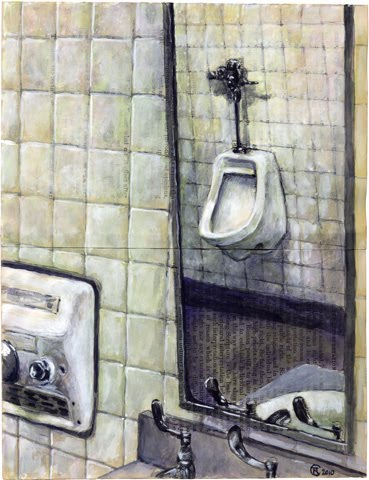
Permanent Fixtures II: Further Travels Through the Male Mind


I have finally reached a point of ambivalence concerning the reception of images and symbols within my artwork. Postmodernist concepts about how we approach both texts and images—with the individual knowledge and baggage that is unique to each person—along with the ramifications of displaying work openly on the internet have paved the way. As an artist, I can never fully manipulate or direct the reception of my work by a viewer.

I actually recognized this fairly early in my career. For a time I was utilizing imagery of rope in my compositions, as a metaphor for being tied to past habits and behaviors. I had several works on display at a coffee shop a few months after my college graduation, including one of the rope works. I received a call with an invitation to meet and talk about the pieces with an area high school art teacher. When we met, he asked me to consider talking with his students about my painting method, since he was primarily a sculptor. In the end, I think he was more interested in asking me out on a date, though he never did and I was oblivious to his motivations.

 
A couple weeks after I met the art teacher I received a phone call from an area gallery. The teacher had suggested my work to the art gallery director for an upcoming show. I was young and pretty excited about the opportunity which had come out of the blue. As the conversation continued, I discovered that the exhibition had a theme of sexual deviance and apparently, because of the one work with rope imagery that I had displayed, I was slated to fill the “bondage” slot. When I explained what that work was really about the conversation quickly cooled, and though the gallery director claimed he wanted to see more of my work, I never heard from him again.


The following year, as I was further developing the rope imagery in graduate school, another humorous misreading occurred. I was working on a self portrait that contained various draped and looped lengths of rope in the background. I actually didn’t think much about the image—it was more like a study or painting exercise. Several of my fellow grad students saw the piece in my studio and inquired if they should be worried about my emotional state. They thought the ropes resembled nooses and that I might be suicidal. I laughed it off and assured them nothing was further from the truth, and I never exhibited the work.
 
When I began my recent Permanent Fixtures series I faced the inevitability of multiple misreadings of the work. My ambivalence is now great enough that this doesn’t bother me. In fact, I embrace the existence of multiple readings and the use of imagery on book pages helps support this. Nonetheless, I do wish to offer some limited explanations that might assist viewers as they approach the work.


As I was trying to research some current scholarship on the concepts I am investigating for this series, I realized that even the terms that I had buzzing about in my head were confused and unclear. I didn’t view the analysis of male self concepts in contemporary culture as a category of gender studies. The whole idea of gender studies often seems to focus on feminist issues. The area of gender studies on college campuses seems to often focus solely on feminism. So, I thought the appropriate terminology might be something closer to gender identity. I soon discovered that that phrase is almost exclusively reserved for the territory of transgender individuals—men who are biologically and anatomically male yet feel emotionally and psychologically female, and vice versa. That was definitely not the intended topic of this work.

The American male psyche is a complex thing. It is not some monolithic and homogenized manner of masculinity and self understanding. At the same time, however, cultural expectations partially govern our assumptions of what it means to be male. This is true for what both women and men expect.

For all the challenges that feminism proposed to counter the stereotypes that existed for American women—the demure, defenseless stay-at-home mom and housewife who keeps an immaculate home and has dinner ready on the table as her bread winner returns home from a long day on the job—there has been little reconsideration of the masculine stereotypes. If roles and identities have shifted on one side of the traditional spectrum then alterations would naturally follow on the other side.
The absence of an on-going dialogue on male identity has led to widespread confusion, though one would hardly recognize it because the traditional male stereotypes are overwhelmingly perpetuated through a stubborn male refusal to talk about “feelings” and “emotional responses.” A necessary question arises. What stereotypical male traits are derived from the biological makeup of the XY chromosomes and what aspects of those stereotypes are exhibited purely from the effects of nurture, including the cultural environment? When we consider the variations of accepted and expected male behaviors in non-Western cultures our American ideals are challenged.

These questions are merely a few that the Permanent Fixtures paintings address. Cultural norms are complex things. When they are paired with the infinitely multifaceted personalities of each human individual the configurations can boggle the mind. A urinal becomes much more than a porcelain plumbing fixture.

Monday, May 17, 2010

Arman: The Sum is Greater than the Parts

The imagery of Pop art was based in the banal—the commonplace items of everyday life. Conversely, the esoteric and existentialist compositions of the Abstract Expressionists did not sit well with the average person. There was little within those swirls and splatters of paint that seemed worthy of the traditional, lofty goals and intentions of fine art.

Pop artists in Britain and the U.S. recovered recognizable imagery, but there was something else at work beneath the surface. Pop’s sister movement in France—Nouveau Realisme (New Realism)—was perhaps a better indication of things to come. The performative nature of art making, by Action Painters like Jackson Pollock, had set the stage for Conceptualism. Yet it was the New Realists who proved to be some of the most innovative transitional figures between mid-century abstraction and process oriented conceptual styles of the 1960s and 70s.

The New Realist artist Arman is not known to the masses like Pop’s Andy Warhol. His individual works are not generally recognized outside of the insulated circle of artists, curators, and art historians who compose the art world. His work, however, contains the germ of transition that formed the foundation for much of the significant work of the later twentieth century.

Arman’s work is mainly composed of collections of ordinary objects. They are certainly the next step forward from the Readymades of Marcel Duchamp. However, where Duchamp’s simplicity was found in the single, unadorned object—the urinal or the bottle drying rack—Arman’s simplicity was often located in his singleness of focus. Arman is primarily known for his “accumulations.” This apt title denotes assemblage collections of similar, real life items and objects.

It was not only the Dadaist Readymades of Duchamp that impacted Arman’s aesthetic. Kurt Schwitters, a Dadaist of a different stripe, composed quite formal looking abstract collages out of detritus. These highly structured and meticulously designed works contain intricate patterns and repetitions. Often, similar items are reused within an individual work. Taken out of their original context, they become non-objective visual elements that enhance the overall impact of the work through a “sameness.” It is that very same element that viewers of Arman’s work find most compelling.

Arman’s art, because of its typical three dimensional nature, can also be aligned with the box constructions of Joseph Cornell. In fact, many of Cornell’s boxes employ repetitions of similar objects, creating an analogous effect. However, Arman should not merely be compared to his predecessors since his relation to his contemporaries is what actually determined his place in art history.


Though both Arman and Yves Klein were both reared in Nice, it was not until they were adults, both studying art, that they became friends and influences on one another. Klein’s work always had a more conceptual and performative aspect, but it originated from a comparable place to Arman’s. Each man studied the martial art of judo (Klein was even bestowed the title of master) and the influence of Asian thinking and philosophies came to bear heavily on many characteristics of their artworks.

Both Arman and Klein typically provided viewers with an art object, yet each often arrived at that object through some form of performative activity. Klein’s Anthropometries may have gained more notoriety (if for no other reason than their blatant exploitation of the female nude) but both artists performed some destructive acts that ultimately resulted in art objects. Some of the Anthropometries even employed flammable actions. Arman also utilized fire to manipulate objects for his works, such as musical instruments.


Arman might smash or burn a cello or violin and then reassemble the remnants as a new art object. This destruction or deconstruction has obvious connections to the theories of both Jacques Derrida and John Cage. Yet, with all the artists who utilized destructive techniques, one should avoid a simple reading that their intentions were set on completely dismantling the concepts of Western art. The influence of Eastern philosophy was often at work and it brings to mind the Hindu god Shiva. The attributes of Shiva include his simultaneous roles as creator and destroyer. There is a direct correlation to this particular subset of Arman’s assemblages.
 
Arman’s work also signals the shifts toward Conceptualism through reconsiderations of established cultural boundaries. John Cage’s blending of art forms—music, visual art, dance, and theater—began to permeate the high art culture of the mid-twentieth century. Robert Rauschenberg and Jim Dine each dabbled in performance art and utilized Duchampian readymade objects in their works, much like Arman. Though mainly recognized as a pioneer in video art, Nam June Paik’s works incorporating violins and cellos are not far afield of Arman’s work with musical instruments.

Often Rauschenberg is seen as an essential bridge between Abstract Expressionism and Pop because his Combine Paintings retained the gestural paint application of the former, while the real life assemblage objects denoted the latter. Arman kept one foot planted in the recent art historical past, too. Examples of this are found in the accumulations that incorporate actual paint tubes, often imbedded—as if in suspended animation—in clear plastic. The concept is not reminiscent of Rauschenberg as much as his colleague Jasper Johns. And the streaming paint brings to mind the soak-stain paintings of Morris Louis more than the drip paintings of Pollock.
For all the similarities with his contemporaries, Arman remains a distinct figure. His style is unique and recognizable. The accumulations, in particular, possess a presence that one is not always able to articulate. There may be elements of humor, as with 1982’s Long-Term Parking, but at the same time there can be underlying political or sociological messages. The abundance of like items or objects within a limited space focuses the attention of the viewer on intrinsic qualities of those objects.
The accumulations recontextualize the materials by stripping away distracting and extraneous elements. The sum of these works is significantly greater than the individual parts. Separated, the objects are often bypassed; combined, the impact of their essential qualities is inevitable.                                                                       The adoption of installation as the preferred medium of so many contemporary artists shows the debt the art world owes Arman. While there are certainly some artists of a new generation who devise compositions through amassing similar objects in an Armanesque style, the collection of disparate objects within a space is more common. Though this may seem to be a distinct differentiation, the recontextualization of non-art objects finds its genesis in Arman as much as in Duchamp. Arman’s accumulations are thus a hallmark of the postmodern desire to deconstruct and then reconstruct meaning from the remnants of Western history and culture.

Monday, May 10, 2010

What Lies Beneath: Underpainting as a Technique

The tradition of building up glazes of pigment to produce a rich and subtle form in painting goes back to the introduction of oil painting as a medium—often attributed to the Flemish painter Jan Van Eyck. In the Renaissance, artists preferred to create an underpainting in a single color on top of which they would layer the glazes that completed an image with a finished, naturalistic appearance.

Over time, the use of glazing as a method of painting fell out of fashion. By the time of the Realists and Impressionists (mid-19th century French painting movements) painters were beginning to favor a more immediate approach, with thicker paint application. This resulted in paintings that resembled something other than the photographs that were becoming increasingly more commonplace.

Even though I experimented with a variety of painting techniques when I was in my undergraduate painting courses (including glazing), I ended up preferring an approach that was closer to Realism. I enjoy the freshness and vibrancy of the colors. In fact, when I now paint just for the fun of it this tends to be the style to which I revert.

When I began painting on book pages the approach of painting with a thicker, more opaque paint soon revealed itself as unsuitable. I started investigating the process of glazing once more. The first problem I encountered was the dullness of color that is often traditionally associated with glazing.

Painters in the Renaissance preferred either the dull green, terre verte, color or a brownish pigment (burnt umber) as an underpainting. Starting with a more neutral color allowed the artists to temper the form with additional colors in order to make the image more vibrant, or less, according to their particular needs.


Some artists, such as Leonardo da Vinci, used a combination of brushes and their fingers or hands to produce the underpainting. Examples, like da Vinci’s unfinished Adoration of the Magi, provide a glimpse to non-painters of what an underpainting entails. A painting, at this stage, is actually more of a drawing. It provides a foundational structure in a full range of values. Leonardo’s finished works tend to exhibit little more color since he preferred a smokier, more atmospheric effect that lacked hard shadow edges.
Duccio was producing paintings in the era prior to Leonardo. Much of his work was actually in egg tempera, a precursor to oil paint. In fact, many artists continued to use tempera as an underpainting even though they completed the glazes in oil. The tempera dries to a hard surface and dries much quicker than the oil medium. In Duccio’s work we can see the effect of the terre verte underpainting. Some pigments fade over time when exposed to light. In Duccio’s work we find the green underpainting showing up as the skin color.

When I began to use glazing again I chose to use a color for underpainting that is not typically employed—purple. You don’t necessarily notice it in the finished works, but the underlying values are completed with this dioxizine purple. This forces me to glaze over the purple with other, equally intense colors. Thus, the images tend to retain something of the vibrancy I prefer, but also the transparency that is desired for the works on book pages. The text is still somewhat readable.

Here I have included some photos of one of the new altarpiece constructions in process. Few people ever get to see my work in this state, before I apply the subsequent layers of color. I chose to share these images to provide some additional insight into the process.

Monday, May 3, 2010

Thomas Demand: The Art of Artifice

The invention of photography forever changed the course of art. While some remain fixed on the old debates on the legitimacy of photography as an artform, the current discussions cluster more around the evolving technologies and their impact on the medium.

Viewers have come to trust the photograph as an accurate form of representation. We know that a camera can capture a likeness in astonishing detail, yet we also know that photos can be manipulated. Even before Photoshop became the dominant digital method for altering photographs, darkroom manipulations were a normal practice in film photography.

Somehow, we like to suspend our knowledge of this fact. We know that adjustments are made to the waists, thighs, and faces of the supermodels gracing the covers of fashion magazines, but we still harbor dreams that their perfection is genuine. If we remove the consumerist element then some doubts about “truth” in other photographs immediately arise. For instance, what is to stop the manipulation of photos used by the media?

When it comes to fine art photography we may recognize that there are manipulations, yet the acceptance of truthfulness as an inherent element of the photograph remains at the subconscious level. German artist Thomas Demand calls our attention to this conflict in his large scale photographs. Demand’s work assesses the unreality of photography. It draws attention to the aspects of artifice that have been linked to photography from the early days of the medium, when portraits were created in a stiff and unnatural manner that spoke more of the slow shutter speeds than psychological insights into the sitters.

As a younger German photographer, Demand has sometimes, inaccurately, been linked to the “Becher School:” those photographers who studied under the husband and wife team Bernd and Hilla Becher at the Dusseldorf Art Academy. Indeed, the immense size of some of Demand’s finished works can favor the pieces of the Becher School, but he should be more closely aligned with the YBAs (Young British Artists such as Damien Hirst, Rachel Whiteread, and Jenny Saville) since he studied sculpture at Goldsmith’s College in London in the early 1990s.

An initial glance at Demand’s work does not suggest the depth of artifice that underlies his work. The images are of simple interior scenes; often rooms that suggest little significance. However, Demand came to photography through sculpture and a close observation reveals the subtleties at the heart of his work.

Each of these interior scenes is a reproduction of an earlier photograph. Usually the original photos are not even taken by Demand but are found in mass media magazines. The artist then recreates the scenes, typically in a 1:1 ratio, using paper and cardboard. It is only after Demand has meticulously rebuilt these scenes that he photographs them.

It is the photos themselves that are the artwork. The paper and cardboard constructions are built in the artist’s studio and quickly dismantled after the photographs are made. The disposable nature of the constructions is similar to the disposable nature of digital photography. With film photography, the artist developed each roll of film and then chose which negatives to print. Sometimes he or she returned to negatives years later, with a fresh eye, and then printed a gem that somehow had been bypassed on initial inspection. Time was an essential aspect of the entire process.

With digital photography, countless “bad” shots are immediately deleted from the camera’s memory. Our need for instant gratification outweighs our patience to find something more subtle. Still, in a twist on this idea, Demand returns to overlooked images and mines them for additional value.

Demand’s scenes are mostly accurate reproductions but not exact reproductions. The most telling and distinguishing features are often eliminated. papers strewn about desktops lack text. Logos and other commercial markings are also absent. This produces generic scenes that would otherwise have specific cultural and historical significance.

A notable exception is the images of the Oval Office. Though titles on the spines of books and identifying facial features from the framed pictures are absent, the familiar colors, patterns, and shapes of the room are true. The somewhat eerie quality of the lighting makes the images seem almost like a 3D digital rendering of the space.

Most scenes seem more innocuous. A janitor’s cleaning closet appears to be just that. One must do some investigation to recognize why the artist would choose this specific photograph. It is one of a series of images that were (originally) taken of rooms at a German pub where a notorious child rape had occurred. The court had restricted photographs of the victim and others connected to the crime scene, so only images of the empty building could be taken.

Demand’s images take the viewer two steps further from the original story. They do, however, retain a sense of the sterility that seems to imply something almost sinister. It is a generic evil that we are not quite able to place a finger on.

A quick glance at Demand’s work exposes nothing special, nothing unusual. The mundane quality of the images can be likened to much of the work of Andy Warhol. Warhol’s “disasters” were also culled from mass media sources. His use of repetitious imagery was a way to comment on our desensitization to the horrors that surround us every day. Many of Demand’s interiors examine a similar theme.

The overwhelming sense within the photographs is that things are not as they appear. Truly, this is a concept that serves the viewer well when approaching any artwork, but particularly contemporary works. There is usually more than meets the eye and only the fully engaged viewer reaps the rewards offered.

Monday, April 26, 2010

In the beginning was the Word

Two recent conversations have reminded me that, while people are intrigued by my use of book pages as a substrate for painting, that material can be disconcerting for others. The first conversation happened when discussing possible materials for use in a drawing student’s final project. I mentioned book pages and she vigorously objected. She said that, having worked for a library, she had too much respect for books to tear the pages out. I assured her that, having worked for three libraries and a bookstore myself, I had no less respect for books.

The second conversation happened via email with a friend and collector. I was describing the recent 1821 German Bible I had acquired from a local used bookstore and noted that I was excited to start tearing the pages out. My friend has actually purchased some of my works on book pages, but assured me that his fundamentalist upbringing has so marked him that he felt he could never tear pages out of a Bible.

It actually took me some time to warm to the idea of removing pages from Bibles and hymnals—or any other books for that matter. I asked a couple artist friends about their use of Bible pages first. I then began experimenting with work on book pages by using books other than Bibles, and texts that I wasn’t planning to keep in my own library. Eventually, I began to use Bibles, hymnals, and other religious texts. I found these in used bookstores and at flea markets. These tend to be forgotten books that have no remaining connection to their original owners.

This German Bible is a good example. It is one of those old, large family Bibles in which people used to write births, deaths, and marriages—the kind that were passed down over generations. There are many things handwritten—in German—on the front pages. I can’t read any of it. It seems, to many people I know, that dismantling such a book, which must have a rich history, is a travesty. That is one way to look at it.

I see the re-use of this book within artworks in a different way. Yes, there are pressed flowers, prayer cards, and a lock of hair scattered between the pages. However, no one had a lasting connection with the people those items represented anymore, otherwise they would not have given the book away. The book is also somewhat unreadable. The pages are riddled with discolorations and foxing. When I use the pages for a painting they get a new life—they are resurrected.

Not only does the text itself matter in the paintings, the connection with history is important. Since many of my works consider the lives of saints—canonized or otherwise—the continuity with those who have gone before us is essential. The quiet lives of the ordinary folks, unknown by the masses, are equally significant in the scope of things.

As an artist, I wish to invite viewers into my work in as many ways as I can. For some, it is the visual images themselves that draw a connection. For others, the existence of text within the works seems like an invitation to learn some deeper truth about the work that the image itself does not readily reveal. There is even a segment of viewers who, sensing the age of the book pages, feel a connection to a common history. These are all valid approaches. Feel free to pick whichever point of entry feels most logical. The work is multifaceted and open to several interpretations.

Tuesday, April 20, 2010

The Sacred Body by David Japser

David Jasper. The Sacred Body: Asceticism in Religion, Literature, Art, and Culture (Studies in Christianity and Literature). Waco TX: Baylor University Press, 2009.


David Jasper’s recent book, The Sacred Body, explores the body through the lens of the ascetic desert tradition, via the forms of art, film, poetry, but especially literature. The author’s background as a teacher of literary theory is apparent in his analysis of all these forms.

While Jasper explains that the text is formed as a continuation of his earlier book The Sacred Desert, this volume, at times, tenuously connects the body to the desert tradition. The reader may easily find herself drawn deeply into what initially appear as various, meandering side discussions only to discover Jasper ultimately forming his connection to the desert through some obscure contextual twist. Since Jasper filters his processing through philosophers from Heidegger and Kant to Derrida and Foucault, it is not surprising that his writing can sometimes read as densely as contemporary philosophy.

Some of the more absorbing aspects of the analysis are revisited throughout subsequent chapters. After an examination of the hagiographical evolution of the figure of St. Mary—transformed over time from Mary Magdalene, to Mary of Bethany, and finally Mary of Egypt—Jasper extends his discussion of the body’s ascetical relevance with an exploration of the character parallel to St. Mary of Egypt in Paul Bowles’ existentialist novel The Sheltering Sky and the adaptation of that work in Bernado Bertolucci’s film of the same title. He rounds out the discussion of the desert life of St. Mary through his commentary on Diego Velazquez’s painting Christ in the House of Martha and Mary. Just as the character of Mary evolves from the historical person(s) to whom she is connected, Jasper’s analysis progresses. The carnal aspects of Mary are tempted and tempered in each art form as her spirit seeks to conform to the guidance of the desert path.

Jasper’s fresh eye on visual art—considering artists as various as William Blake, Hans Holbein, and Vincent van Gogh—is similar to Henri Nouwen’s. It resides somewhere between the explicitly theological and the intimately devotional. He is aided at times by the writings of art critics Arthur C. Danto and Leo Steinberg, which is a welcome supplement to his own analysis. Jasper is clearly more comfortable when he stays closer to his literary roots. His scrutiny of the Hans Holbein painting The Body of the Dead Christ in the Tomb relies heavily on the discussion of that work within Fyodor Dostoevsky’s The Idiot. Like Mathias Grunewald’s Isenheim Altarpiece—also discussed by Jasper—the Holbein work focuses on the scourged and crucified corpse of Jesus. Both of these paintings establish a transformed understanding of the physical being—focusing on a glorified body. Christ’s taking on of mortal human flesh is pushed to the extreme when these artists examine the death of God and the perplexities and mysteries of the incarnation through the divine Word made flesh. Yet for the flesh to be renewed and resurrected, it must first suffer death. Jasper addresses this significant point in relation to ascetic practices, not simply glossing over the expansive implications of Christ’s incarnation as paralleled in the way of the desert.

It is Jasper’s knack for mingling odd bedfellows that produces some of the most satisfying "perplexities" in the book. The works of Meister Eckhart and James Joyce form the core components of a chapter devoted to holiness and the resurrection of the body. The mystical contemplations of Eckhart may seem a natural match for a discussion on the holiness sought in the desert. It is the pairing with Joyce’s Finnegans Wake that comes as an initial surprise. In Joyce’s work, Jasper finds a parallel to the incarnation of the Word. The reader must be fully present in the text, a text that reveals itself—if somewhat opaquely—through its aural recitation. In both Eckhart and Joyce the reader is lost within the poetry of the words, becoming one with the text just as the ascetic believer seeks to be united with the holiness of Christ.

Jasper concludes his analysis with a chapter that acts as a template for future theological readings—whether pure theological texts or theology nestled within the guise of the various arts. For Jasper, the ascetic tradition is simply a system by which one lives out life liturgically. We may each approach our lives through an ascetic lens if we choose. Jasper offers possibilities of bodily "dwelling" in this life through the ascetic tradition. He suggests dwelling: on the edge, in anticipation, as vigil, with consistency, at the end of history, in dispossession, and in perfect joy. These approaches are meant to act as filters that usher us into the way and wisdom of the desert.

Saturday, April 10, 2010

Karma Chameleon

Having a variety of interests can pose a challenge. For me, it has never been quite like the saying about the Jack-of-All-Trades, but dividing time among a multitude of interests certainly takes time from those things about which one is most passionate.

In the late 1990s, when I was teaching full-time, I tended to use the semesters as a time for reading, research, and sketching. Printmaking, particularly, was accomplished in the summer months. In those months there was plenty of time and no one else using the studio. When I was later working full-time as the director of an art non-profit there were no summer breaks, though I kept generating complex ideas for future artworks.

Having the ability to devote nearly all of my time to producing art over the past year and a half opened my eyes to something. I can never keep up with all the ideas. Even though I am producing exponentially more artwork than before, it takes time to actually create it. While carving a woodblock or painting on a book page a new thought is bound to enter my mind—another rabbit hole is opened and the chase begins again.

Occasionally, the reason I take several years to complete a piece has nothing to do with the time it physically takes to complete it. Many of the altarpiece constructions are developed through sketches and the assemblage items are devised at that stage. I often have some items collected already, awaiting an altarpiece in which they can be placed. At other times I imagine an object I would like to use, but then I have to search to find it.

The hunt is always on. I have previously relayed stories on this blog about my search for chattering teeth and doll parts. My great white whale, for several years, was a chameleon figurine. Aside from eBay and Google searches I have looked at dozens of flea markets, antique stores, and junk shops everywhere from New York City to Los Angeles—I mean this literally. There was a glimmer of hope in New Haven, CT when I spotted a plastic chameleon in a shop window display. It was, unfortunately, there for effect but not for sale.

When I recently stopped into an arts and crafts supply store, for an unrelated item, I spotted a wooden lizard. It was a somewhat generic lizard, but I knew it could easily be transformed into my reliquary chameleon. After I bisected a glass bead, for the eyes, hollowed out some eye sockets, and applied paint and gold leaf, the chameleon was complete. One of the best parts is that it still functions like a child’s toy—giving it a certain Joseph Cornell air.

I imagine that through all this discussion you may be wondering, "Why would you place a gilded chameleon in a reliquary anyway?" Without divulging too much about the work in progress, I will mention that the chameleon reflects the very sentiments with which I began this essay. Many of us live multifaceted lives in which our various interests cause us to become "all things to all people."

Political correctness has so subdivided our society into various, predetermined, sub-cultural roles that we often find ourselves exhibiting one form of behaviors in one setting and a completely different set in another. While I am not implying that we are being untruthful or immoral in any of these actions, I do suggest that this belittles the complexity of who we are as human beings. We cannot be defined by checking off the boxes that best describe our main interests and personality traits.

In order to navigate this complex terrain we have learned to acclimate to each new circumstance. The chameleon-like ability to do this is held sacred to many. Considering that most of us will now change careers nearly half a dozen times in our lives, this might be thought of as an asset. Conversely, we may want to criticize a culture that vigorously opposes any ambiguities or "seemingly" antithetical beliefs or interests held by an individual. Philosophies and ideologies are far from perfect and it will take our entire lives to decipher our personal belief systems. These will also change and transform over time. The chameleon is, therefore, an accurate portrayal of our human growth and self understanding.

Sunday, April 4, 2010

Lucian Freud and Jenny Saville: The Full Weight of the Body

Rumors concerning the death of painting have perpetually surfaced for half a century now. Yet the pluralism of postmodernism has left sufficient room for this more ancient form of art to remain. That being said, the role of the realist figurative painter seems to shrink a little more each year. In Britain, however, which has tended to champion some of the most innovative and non-traditional artists for the better part of two decades, there remains an unbroken line of figurative painters.

This is not an endless chain of teachers and pupils who pass down a strictly academic style of paint application, technique, and style; rather, there remains a continual fascination with the human form and its attendant psychological trappings. The subject of psychology and matters of the mind naturally brings us to the grandson of Sigmund Freud—Lucian Freud. Freud, the painter, has been hailed by many as the most important contemporary figurative painter for the past few decades.

Psychological states are certainly integral to Freud’s canvases, but physicality is really the dominant feature. The painter’s style, which began in a more surrealist vein, progressed to a maturity based on the physical qualities of the paint itself. By the 1980s the paint was not just a tool employed to present a facsimile of a human form on canvas. The encrustations of the medium and pigment on the canvas surface took on a substantial physicality of their own which bore the fullness of human presence.

The broad view of Freud’s work suggests an interest in humanity’s complexity and dignity. Again, as the work matured, the scenes depicted became less like staged theatrical productions—less like historical or mythological scenes of the past—and more like the focused gaze of an artist within his studio. Aside from strict portraits (most notably his 2001 portrait of Queen Elizabeth II), the bulk of Freud’s paintings are quite obviously models posed within the arena of the artist’s studio.

By stripping away the props and accoutrements of some fictional, staged scene—and often the model’s clothing—Freud directs our focus on the person or persons as he views them. These are typically friends and family members. The artist feels a need to know his models. The result is that his familiarity produces such a high level of vulnerability (on the model’s part) and scrutiny (on the artist’s part) that we are drawn past the magnificent surfaces into the hidden psychological aspects below. This forms a grafting of the physical with the psychological.

Freud’s work is often linked to the confident corporeality of his subjects. Rotund figures with excessive mounds of flesh have become a trademark. At times these figures seem little more than an exercise in the mastery of materials. The protuberances of paint are a stand-in for the folds of flesh, though a mere masterful bravado is seldom the end. The starkness of these immense figures within the limits of the studio space provides a glimpse beyond their sheer fleshiness and beyond that sole trait that we most often associate with an obese figure—the immensity of his or her physical body.

One of Freud’s most notoriously fleshy works—Benefits Supervisor Sleeping—sold at auction from Christie’s in New York in 2008 for $33.64 million.The estimated selling price would have made it the highest selling work by a living artist at that time. Yet all the publicity aside, this painting brings several signature elements of Freud’s work into alignment. The fleshiness and encrusted paint surface are coupled with the placement of the figure inside a studio setting, in a pose that heightens the sense of her physical weight with psychological heft. Still, the work is steeped in the tradition of the male gaze and the complicated heritage that that implies after the introduction of feminist theories.

Fellow Brit Jenny Saville approaches the figure with the sensibilities of a younger generation. She keeps one foot firmly planted in the figurative tradition that includes both Freud and Francis Bacon, but she is also ranked among the YBAs (Young British Artists) who rose to prominence in the mid-1990s. Her contemporaries are artists like Damien Hirst. Both artists were included in the infamous Sensation exhibition that induced cultural tremors when displayed at the Brooklyn Museum in 1999. Saville’s work may seem conservative in comparison to Hirst’s, but something more than a cursory glance reveals shared traits with the other YBAs.

Saville’s images are typically viewed through the lens of feminism, but that is too narrow a construction. The paintings that exhibit lines and shapes drawn onto the naked skin of fleshy females (Plan) imply the pre-surgical markings of a plastic surgeon. The artist actually observed plastic surgeries in the year after her art school studies. While there are connections to body image and the pressures placed on women in contemporary cultures—worldwide and not just in the West—the work is more expansive than that.

Saville’s figures do not merely exhibit a density of flesh, they often allude to severe physical traumas. The figures are wounded at times, yet the viewer is uncertain whether these are self-imposed traumas or the results of living in a tragic, broken world. Hybrid (1997) seems like a patchwork quilt of skin—a body mismatched to its ill-fitting parts. And this idea of not necessarily feeling at one with the body is a recurring theme in Saville’s work.

The displacement is most noticeable in the works of transvestites and transsexuals. There remains a uniquely female gaze, even in these works. To take these specific paintings on their own, divorced from Saville’s entire oeuvre, is to misread them. Saville is not simply concerned with issues of gender identity, nor even the finer points of feminism. Her work rings truer when linked to the universal theme of self identity.

Like Freud, Saville is exploring the linkage of body and soul. The physical weight sensed in a representational style and the inflictions enacted on Saville’s figures both allude to the woundings of the psyche and the immensity of existential crises in modern and contemporary human beings.

The adoption of the figure as the primary image in periods following the rise to prominence of abstraction and non-objectivity can be risky. It has sometimes been aligned with a non-progressive traditionalism that has been touted as irrelevant. The Greenbergian criticisms that still echo through contemporary art criticism favor elements of the chaotic and performative. And while analysis of art in these terms has trickled down to our larger culture in diluted forms like "reality television," it only subtly impacts the thinking of the average person. That is a primary reason why the figure has not disappeared in contemporary art. Its presence acts as a necessary ligament connecting the ordinary person to his or her place in the wider world.


In viewing the paintings of Freud and Saville we are each confronted with more than naked humanity. Ultra-physical bodies resonate with our own primal needs to uncover the complexity of being—physically and spiritually—and the implications that hold sway over our every day existence. This is why figurative work will never go out of fashion; our figure-to-figure relationship with artwork is a basic and necessary human experience.